TRADE JOURNAL

Trade Journal for Binary Options Traders

A trade journal for binary options is a structured record of every decision: the asset, direction, expiry reasoning, emotional state at entry, and session context. Not just whether you made money.

Binary options trading compresses decision cycles into seconds or minutes. The pressure makes behavioral patterns harder to see — and more important to track.

TradeReality is built for this: manual trade entry, session review, behavioral tagging, binary edge analysis, and a monthly review system — without signals or predictions.

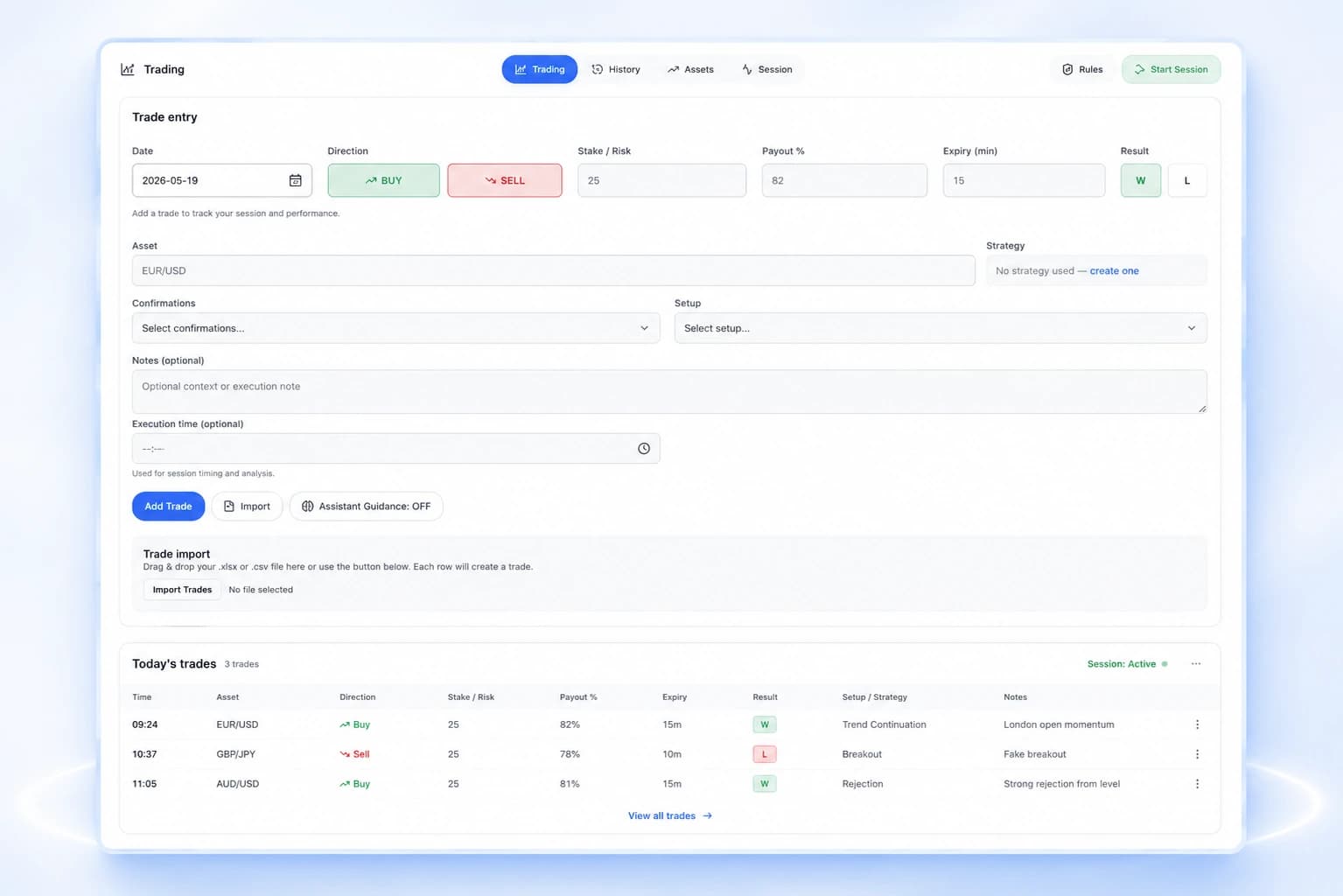
TradeReality trade entry screen with fields for asset, direction, expiry, and trade reasoning

What makes binary options trading different to journal

Most trading journals are designed for position trades or swing trades where time in the market is measured in hours or days. Binary options trades expire in seconds, minutes, or hours — which changes what needs to be captured.

In binary options, the expiry duration is a decision in itself, not just a parameter. Choosing a 1-minute expiry instead of a 5-minute expiry is a behavioral act driven by setup logic, urgency, or emotional pressure. A trade journal that does not capture expiry reasoning is missing a critical behavioral data point.

Compressed decision cycles

Fast expiries increase emotional pressure and urgency — which is exactly what needs to be logged.

Expiry as a decision

Why a specific expiry was chosen reveals whether the trade was strategy-driven or emotion-driven.

Session volume risk

Short expiries make overtrading easy. Session rules and trade count context must be tracked.
What a trade journal for binary options should capture

Each trade entry should answer two questions: what was the execution and what was the behavioral context. Here is what a complete binary options trade record includes:

  • Asset and direction — what was traded and which way
  • Expiry duration — how long the trade was set for
  • Expiry reasoning — why that duration was chosen (strategy or urgency?)
  • Setup criteria — what specific conditions justified the entry
  • Emotional state — confidence, urgency, fear, or hesitation at the time of entry
  • Session context — trade number in session, session P&L at entry time, session rule status
  • Post-trade observation — what you noticed about the execution and the result

Expiry logic and behavioral pressure

The relationship between expiry selection and emotional state is one of the most revealing patterns in binary options trading. When a trader under pressure consistently selects shorter expiries, that is a behavioral signal — not a strategy refinement.

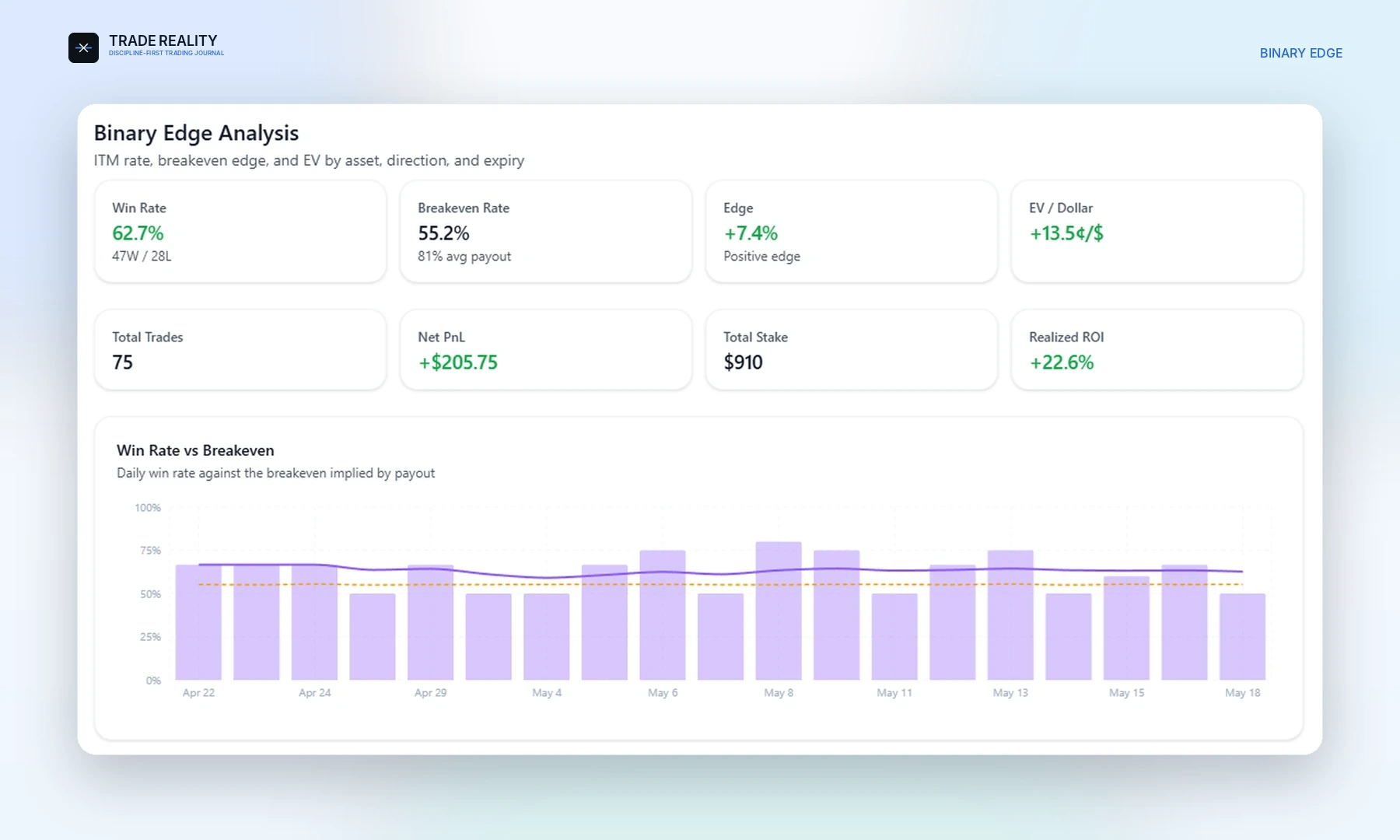
Binary edge analysis in TradeReality breaks down win rate and result quality by asset, direction, and expiry cluster. This makes it visible whether a specific expiry duration consistently underperforms — and whether that coincides with sessions where emotional pressure was logged.

Understanding this pattern does not require guessing. It requires logging expiry reasoning and emotional state for enough trades that the pattern becomes statistically visible.

TradeReality binary edge analysis showing win rate by asset, direction, and expiry breakdown

How TradeReality serves binary options traders

TradeReality is designed around the review cycle that binary options traders need: session-level tracking, behavioral tagging, expiry analytics, and a monthly review system that shows behavior trends — not just outcomes.

Everything is manual. No broker connection. No automatic import. Your journal entries are your own data — not aggregated, not shared, not used to send signals.

Manual trade entryLog each trade with full context: asset, direction, expiry, setup, emotion
Binary edge analysisWin rate vs. breakeven segmented by asset, direction, and expiry
Session heatmapTime-block performance patterns across your session history
Journal historyFull text journal entries linked to sessions and individual trades
Monthly PDF reviewStructured monthly summary with behavioral focus and trend notes
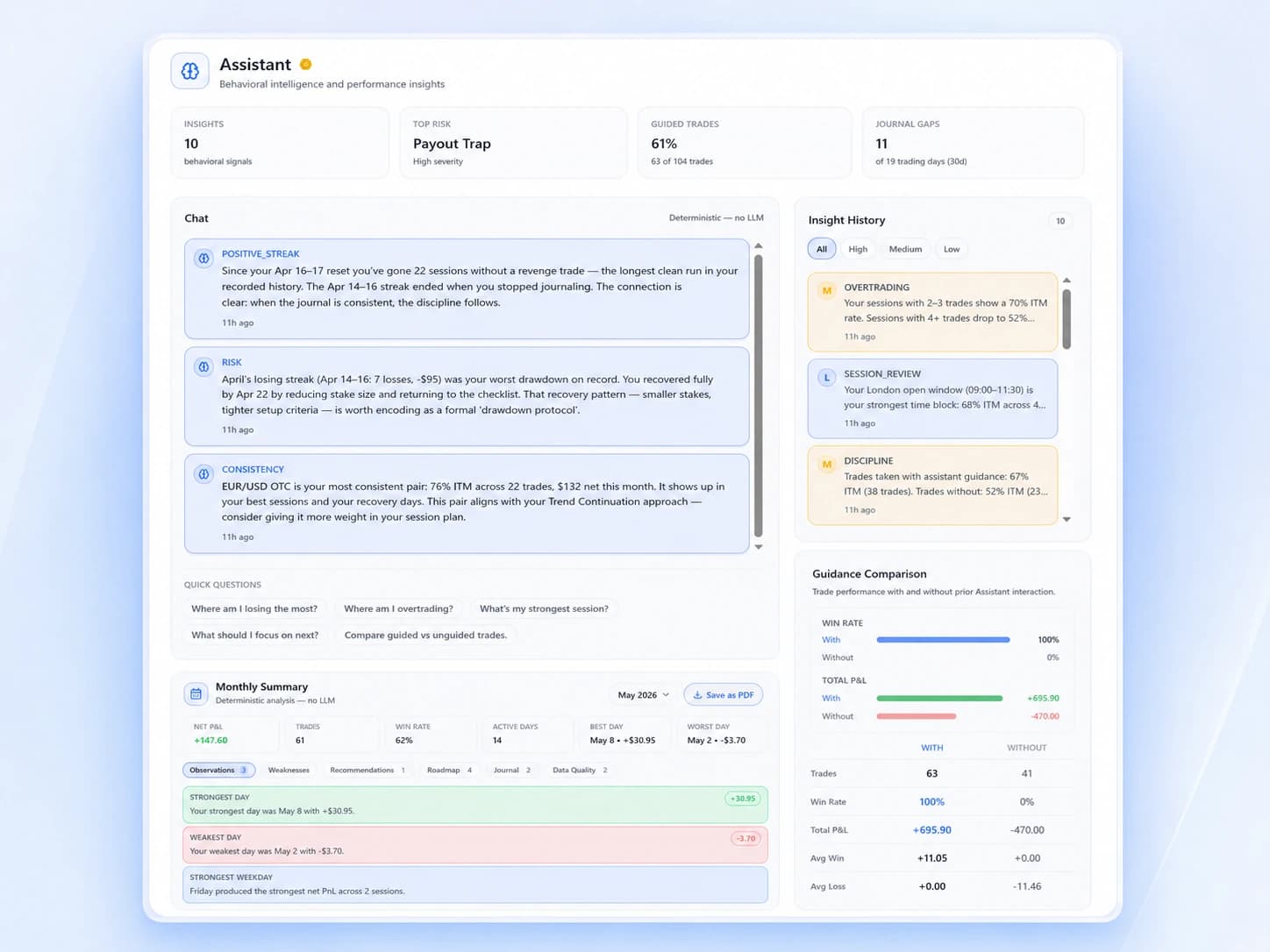
TradeReality assistant workspace analyzing behavioral patterns from your own trade journal data

FAQ

What makes a trade journal specific to binary options?

Binary options require logging expiry duration and reasoning alongside the standard setup fields. Without expiry logic, the journal cannot distinguish strategy-driven timing from emotional urgency.

What should I log after every binary options trade?

Log the asset, direction, expiry duration and why you chose it, your emotional state at entry, whether the trade followed your session rules, and a post-trade observation note.

Can I use a generic spreadsheet for binary options journaling?

Spreadsheets can capture raw data but lack session structure, behavioral tagging, review workflows, and pattern-detection tools — all of which matter for improving binary options execution over time.

Does a trade journal predict which trades to take?

No. A trade journal records past decisions to make behavioral patterns visible. It does not predict market outcomes or suggest which trades to enter.

Is TradeReality connected to any binary options broker?

No. TradeReality is not affiliated with or connected to any broker. It is an independent manual trade journal with no automatic import or broker sync.

What is expiry reasoning and why does it matter?

Expiry reasoning is the recorded rationale for why a specific expiry duration was chosen. Logging it exposes whether timing decisions were driven by strategy or emotional urgency — a key distinction for behavior review.

Start your binary options trade journal.

Free plan includes manual trade entry, basic dashboard, and recent trade review. No broker connection required.

Disclaimer: TradeReality is educational analytics software. It does not provide financial advice, trade signals, or market predictions. Trading binary options involves significant risk of financial loss. All trading decisions remain solely with the user.