Why Most Journals Do Not Improve Execution
When journaling is only outcome tracking, behavior remains invisible.
Without decision context and review loops, the same mistakes repeat under different market conditions.
TRADING JOURNAL
A trading journal is a structured record of decisions, execution quality, and post-session review.
Most traders only track PnL. That hides behavioral causes and makes process improvement difficult.
A process-first journal captures context, rule adherence, and corrective actions session by session.
When journaling is only outcome tracking, behavior remains invisible.
Without decision context and review loops, the same mistakes repeat under different market conditions.
Use a repeatable structure so every session can be reviewed consistently.
01
Record market conditions, setup criteria, and invalidation logic before execution.
Pre-commitment reduces impulsive reinterpretation during live pressure.
02
Log entry timing, adherence to rules, and execution deviations.
Execution data separates strategic intent from behavioral drift.
03
Evaluate what happened, why it happened, and what changes next session.
Review closes the feedback loop and turns mistakes into correction tasks.
04
Cluster repeated mistakes and trigger conditions over multiple sessions.
Pattern visibility enables targeted behavior stabilization.
Build measurable process consistency with discipline, psychology, and execution tracking in one workflow.
Scenario
A trader enters before full confirmation in volatile opens.
What happened
PnL-only tracking shows inconsistent outcomes, but not decision quality.
Why it happened
Journal tags reveal urgency-driven entries after prior losses.
How tracking solves it
With tagged review, the trader applies a delayed-entry checkpoint and reduces rule breaks.
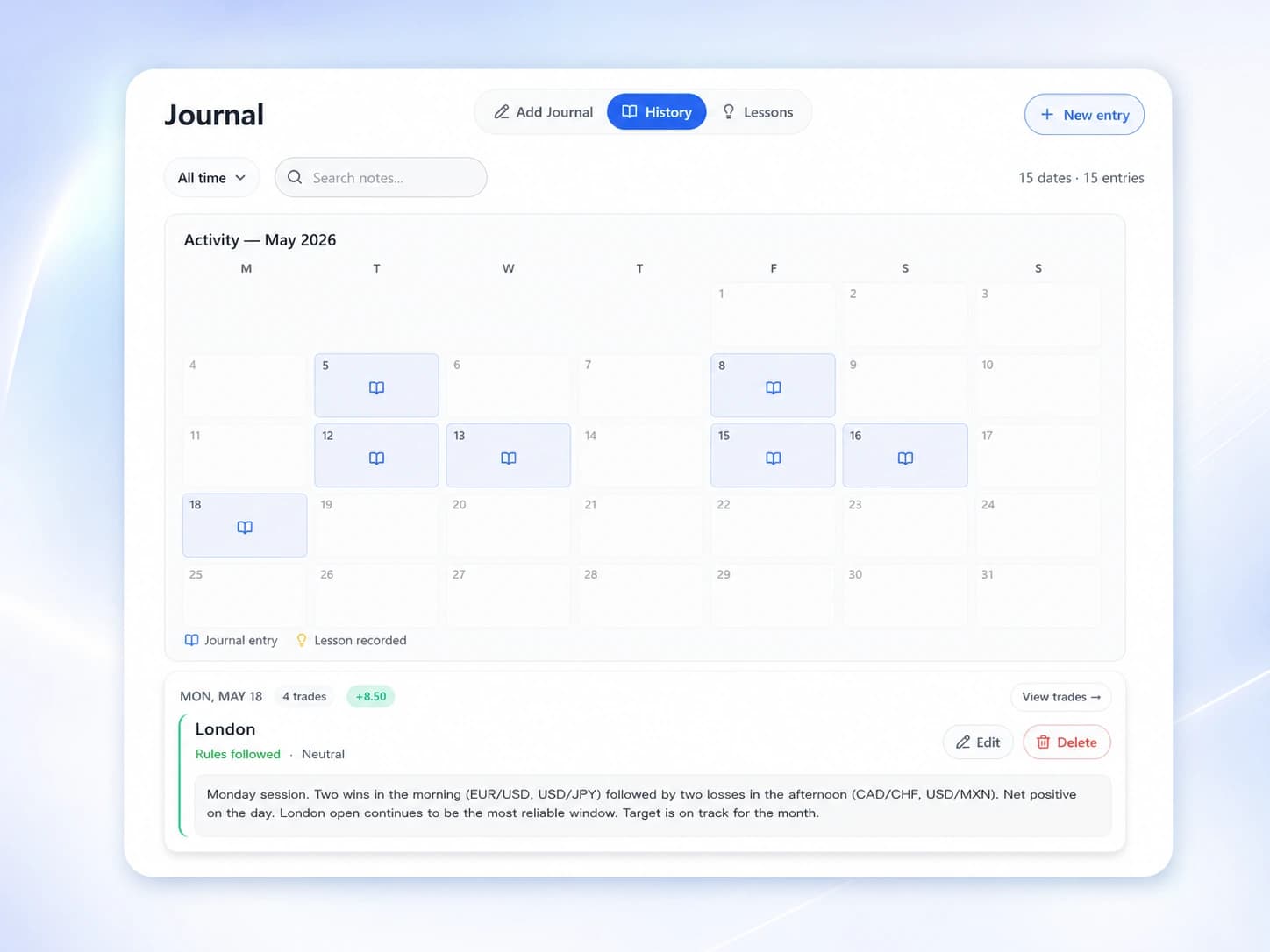
TradeReality connects journal entries with behavior and execution diagnostics.
Capture setup, timing, rule checks, and decision context in one workflow.
This standardizes session data for clearer review.
Tag emotional and cognitive triggers directly on decisions.
You can isolate behavior patterns behind repeated mistakes.
Convert observations into next-session correction actions.
Improvement becomes measurable instead of subjective.
What should a trading journal include?
A strong journal includes pre-trade context, execution details, rule adherence, emotional tags, and review actions.
Is a trading journal only for beginners?
No. Experienced traders use journals to maintain process consistency and detect subtle behavioral drift.
How often should I review my journal?
Run quick daily reviews and deeper weekly reviews to detect recurring patterns.
Can journaling improve discipline?
Yes. Structured journaling makes rule deviations visible and easier to correct over sessions.
No broker connection required.
TradeReality supports process-first journaling, review workflows, and behavioral diagnostics for discretionary traders.
Related Guides