SESSION ANALYTICS

Trading Session Review for Better Pattern Recognition

A trading session review treats the session as a unit — not a collection of individual trades. It captures how behavior evolved across the session, where rules were maintained or broken, and what patterns appeared.

Session-level analysis reveals what individual trade review misses: the progression from calm to urgency, the point where overtrading began, the time blocks where execution consistently weakens.

TradeReality is built around this review cycle. Sessions, time blocks, journal entries, and behavioral indicators are captured together so the full session picture is visible — not just the trade list.

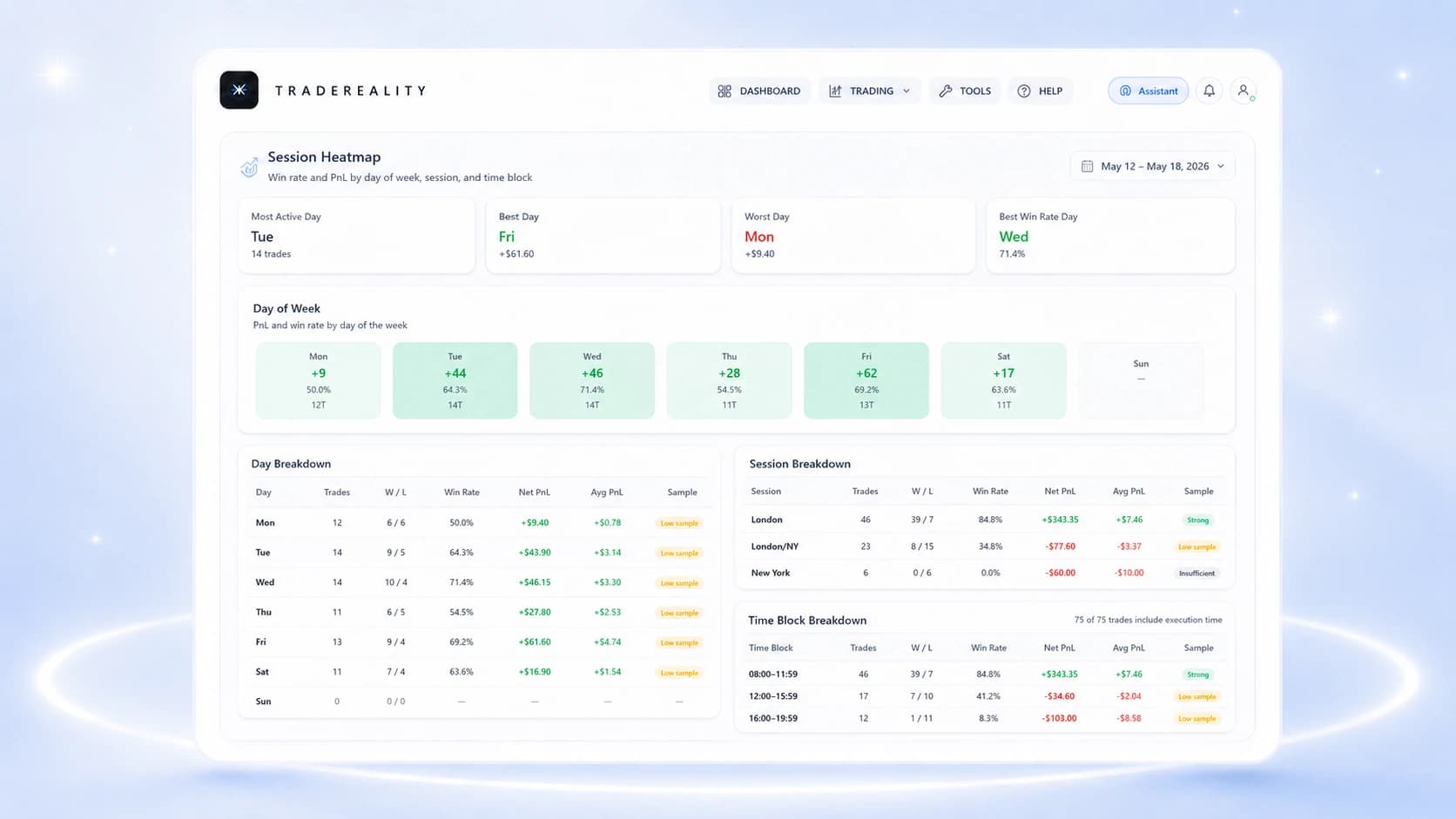
TradeReality session heatmap showing time-block performance patterns by hour and day of week

What is a trading session review?

A trading session review is a structured end-of-session analysis that looks at the session as a whole, not trade by trade. It asks: were the session rules maintained, how did behavior evolve as the session progressed, what triggered any rule breaks, and what is the correction action for the next session?

The goal is not to evaluate each trade independently. It is to understand the session arc — from opening conditions to final trade — as a behavioral unit that can be compared to other sessions over time.

Session as a unit

The full arc from first to last trade, including the context that made each decision possible.

Rule adherence tracking

Whether session rules were maintained — and if not, exactly when and why they broke.

Behavioral arc

How emotional state evolved across the session and what triggered any shift.
What to include in every session review

A complete session review covers both the execution layer and the behavioral layer. Here is the structure that makes session reviews comparable across many sessions:

  • Session rule adherence — were all session rules followed? If not, which ones and when?
  • Trade quality by session phase — how did early, middle, and late session trades compare?
  • Emotional state evolution — did calm shift to urgency or frustration? When did it happen?
  • Session P&L context — did a win or loss in the first hour affect subsequent decisions?
  • Trigger identification — what specific event or condition caused any behavioral shift?
  • Next-session correction action — one concrete change to test in the next session

Time blocks and weak periods

Not all time blocks within a trading session perform equally. For most traders, there are specific hours where execution is more consistent and others where it consistently weakens. Session review makes these patterns visible.

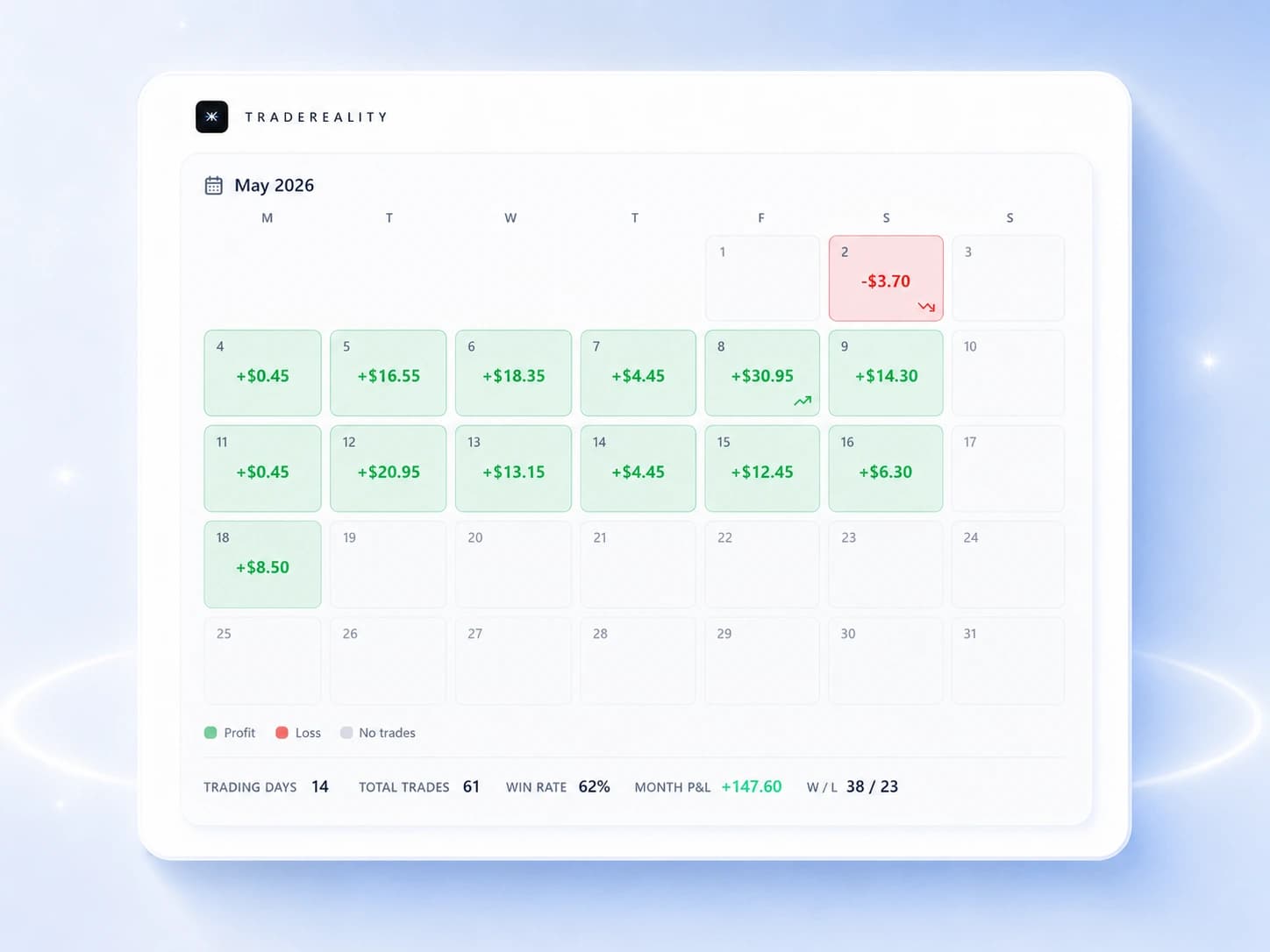
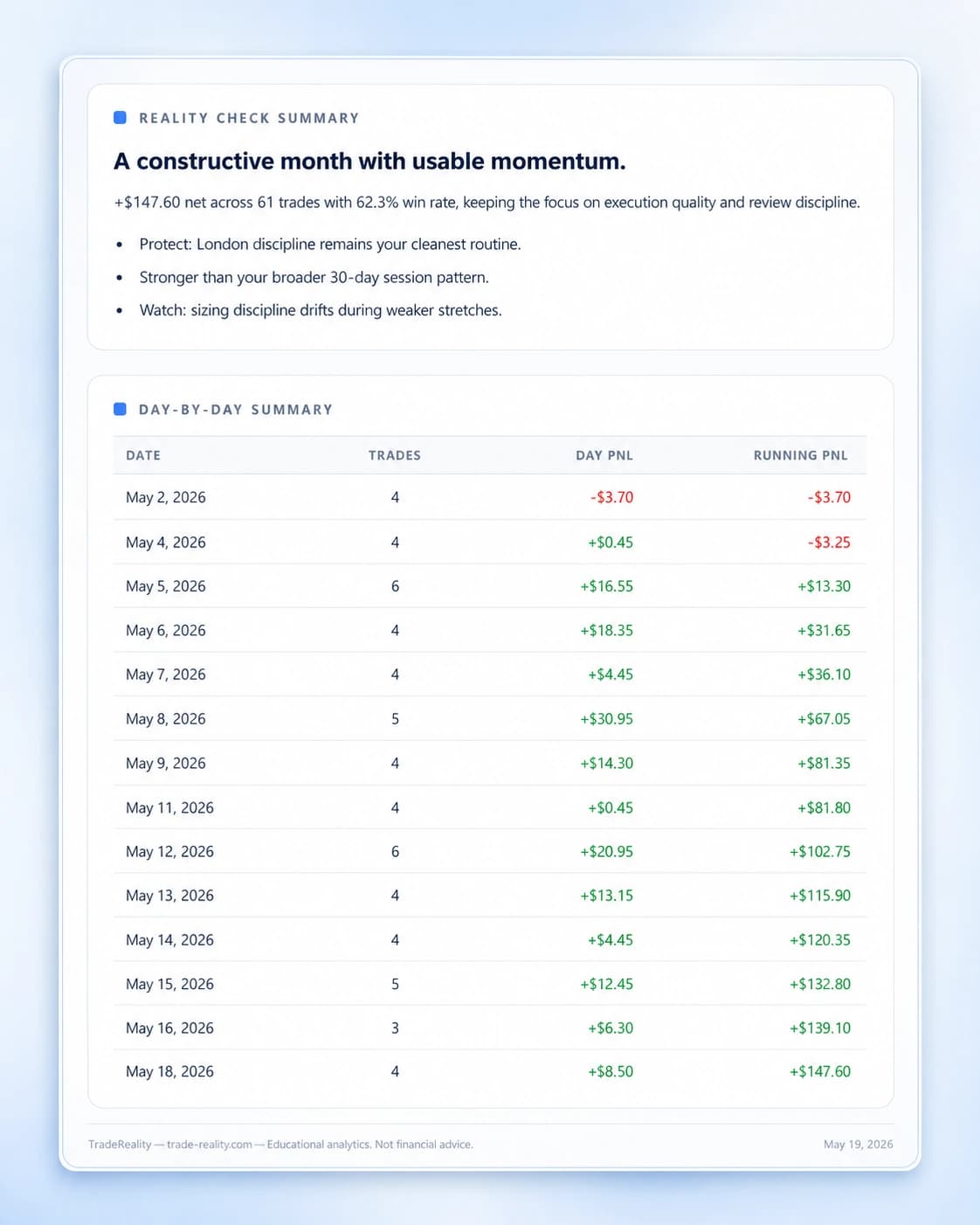
The monthly day-by-day view in TradeReality shows session-level results across the calendar — so you can see which days of the week and which weeks of the month correlate with stronger or weaker execution.

Over 20 to 30 sessions, time-block patterns emerge: perhaps the third hour of trading consistently shows the highest rate of rule breaks, or Friday sessions consistently underperform Monday sessions. This is the data that makes session rule adjustments evidence-based rather than intuition-based.

TradeReality monthly review showing day-by-day session performance with behavioral notes

How TradeReality supports session review

TradeReality is built around the session review cycle. Each session is a structured unit: trades are entered with context, a session journal note is written at the end, and the analytics system aggregates sessions over time to surface patterns.

The assistant works only from your recorded sessions and journal entries. It does not provide signals, predictions, or market commentary. It surfaces what your own data shows.

Session heatmapTime-block performance patterns segmented by hour and day of week
Daily P&L calendarSession-level outcomes with journal markers and behavioral flags
Monthly day-by-day reviewWeek-by-week and day-by-day session performance across the full month
Journal historySession notes and behavioral observations linked to specific sessions
Trading targetsSession rules tracked as targets — measure adherence rate, not just results
TradeReality P&L calendar with session markers, journal indicators, and behavioral flags

FAQ

What is a trading session review?

A trading session review is a structured end-of-session analysis covering what happened, why, and what to adjust. It looks at the session as a unit — not individual trades in isolation.

How is session review different from trade review?

Trade review evaluates individual decisions. Session review evaluates the overall session flow — whether rules were maintained, how behavior evolved as the session progressed, and what patterns appeared across the full session.

What should I include in every session review?

Include session rule adherence, emotional state evolution across the session, trade quality by session phase, the trigger for any rule breaks, and one correction action for the next session.

How many sessions do I need before patterns become visible?

Meaningful patterns typically require 20–30 sessions of consistent review. Single-session observations are starting points, not conclusions.

Does TradeReality analyze sessions automatically?

TradeReality provides analytics and surfaced patterns from your recorded session data. The assistant works only from your own journal entries — no external data, no signals, no predictions.

Can session review predict which time blocks will perform better?

No. Session review shows what your past sessions have produced in different time blocks. It does not predict future outcomes. It reveals historical patterns that you can use to inform your session rules.

Start reviewing sessions with evidence.

Track session rules, time blocks, behavioral patterns, and monthly trends — without signals or predictions.

Disclaimer: TradeReality is educational analytics software. It does not provide financial advice, trade signals, or market predictions. Trading involves significant risk of financial loss. All trading decisions remain solely with the user.